
Postdoctoral position in metamorphic petrology and numerical modelling
We are seeking a motivated postdoctoral researcher to join our three-year FWF-funded project Decoding Thermal Histories: Uncoupling Chemical and Mechanical Heat Production at the University of Graz. The project combines thermodynamics, numerical modelling, metamorphic petrology and petrochronology to explore how hydration reactions and deformation produce transient heat and modify the geological record. We particularly welcome candidates with a strong background in thermodynamics and numerical modelling using MATLAB, Python or Julia who are excited to connect quantitative models with observations from natural rocks.
The project can begin in early 2027 and must start no later than 1 March 2027.
Interested? Get in touch via simon.schorn@hotmail.com
Download the full advertisement and application details here.
Application deadline: 15.10.2026

Paper alert! Incipient continent formation by melting of altered mafic protocrust
Understanding the formation of Earth’s continental nuclei during the Archean eon is key to reconstructing early geodynamics, but direct evidence is scarce. We report a 3565 Ma melt-bearing amphibolite from the Sylvania Inlier, Pilbara Craton (Australia), predating most exposed rocks in the region. Its low δ¹⁸O values and melt compositions resemble evolved Hadean crust, suggesting a common source. Thermodynamic modelling indicates partial melting occurred at 680–720 °C and 0.8–1.0 GPa (~30 km depth). These findings support models of continental nucleus formation through shallow partial melting of hydrothermally altered mafic protocrust in high heat flow settings.
New paper out! Melt-Supported Strain Localization in Eclogites
In high-pressure settings dominated by dry mafic rocks, strain commonly localizes in eclogite, though the underlying mechanisms are not fully understood. This study integrates field, microstructural, petrographic, and geochemical data to explore strain localization in eclogite-facies shear zones. Two distinct eclogitic assemblages are observed: a host-rock eclogite and sigmoidal enclaves originally formed as plagioclase-rich cumulates. Although initially weaker, the enclaves became stronger than the host during metamorphism, as evidenced by their shape and the development of ultramylonitic eclogite around them. The host deformed mainly through melt-assisted grain boundary sliding, while the enclaves deformed via dislocation creep and grain growth. These findings reveal a metamorphism-driven strength inversion that focused stress at lithological boundaries, promoting strain localization in the weaker eclogitic matrix. The study underscores the importance of compositional heterogeneity in controlling deformation at high pressures.
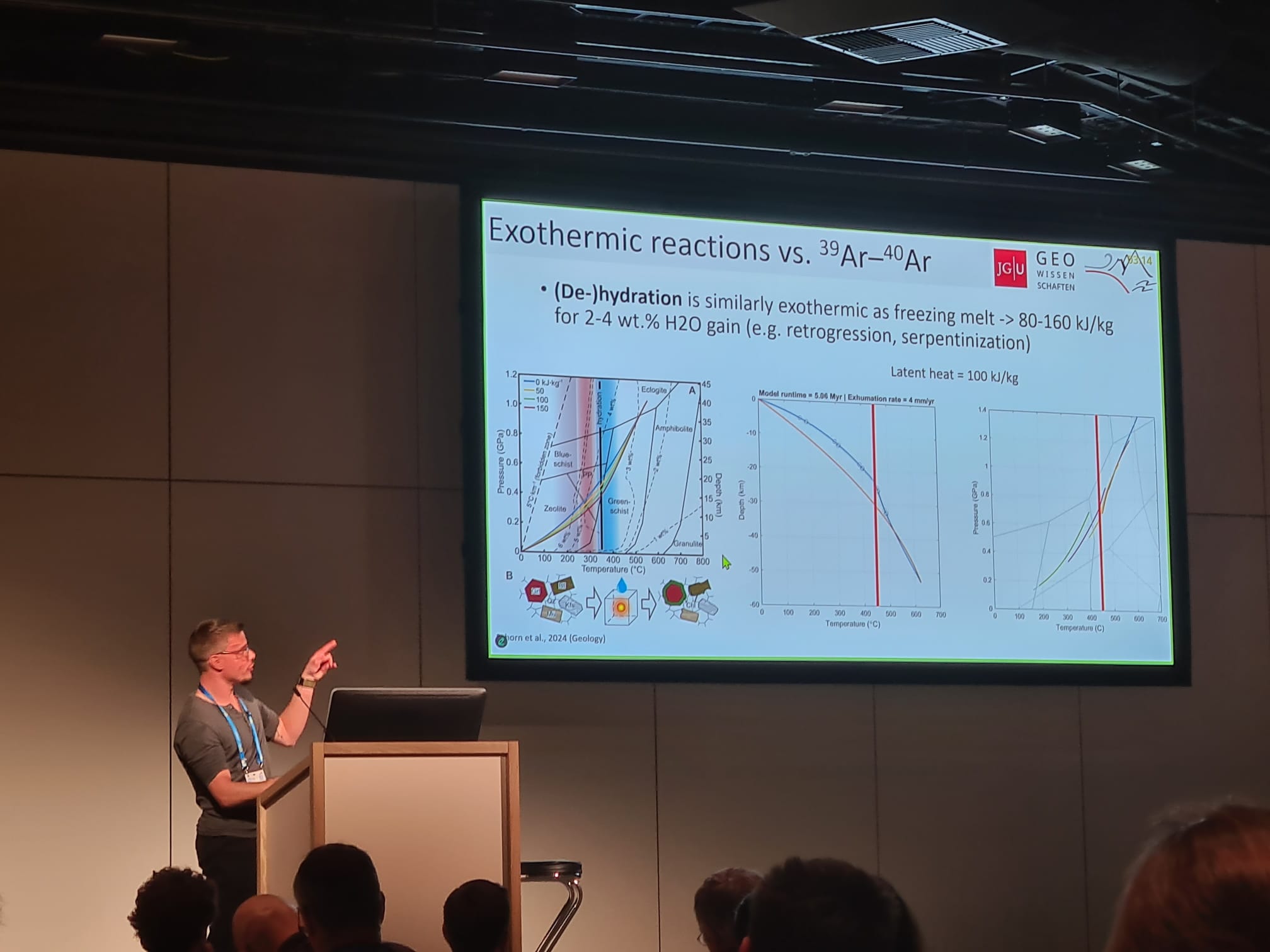
EGU 2025 | Latent heat of metamorphic reactions: boosting diffusion – hampering cooling
I had the pleasure to present some of our work, have some stimulating discussions and catch up with old friends. Great times!
Vienna, 30.05.2025
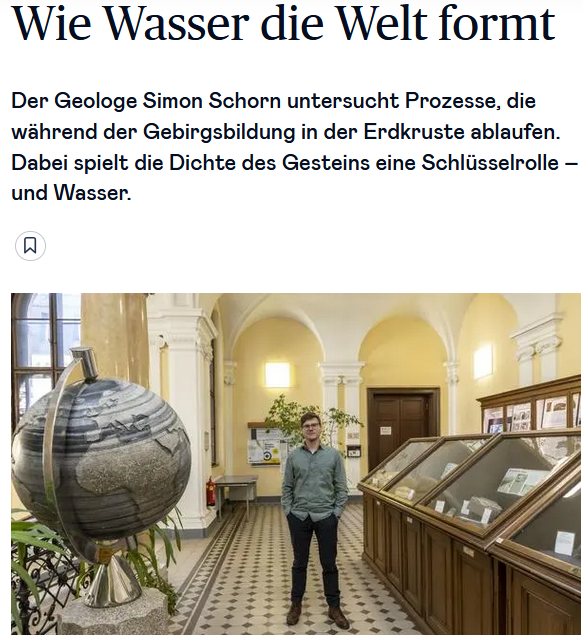
Interview with “Die Presse” regarding my research
I had the privilege to be interviewed by “Die Presse” for an online contribution around “young research” where I could give some insights about my research and career path (in german).
Graz, 09.03.2023
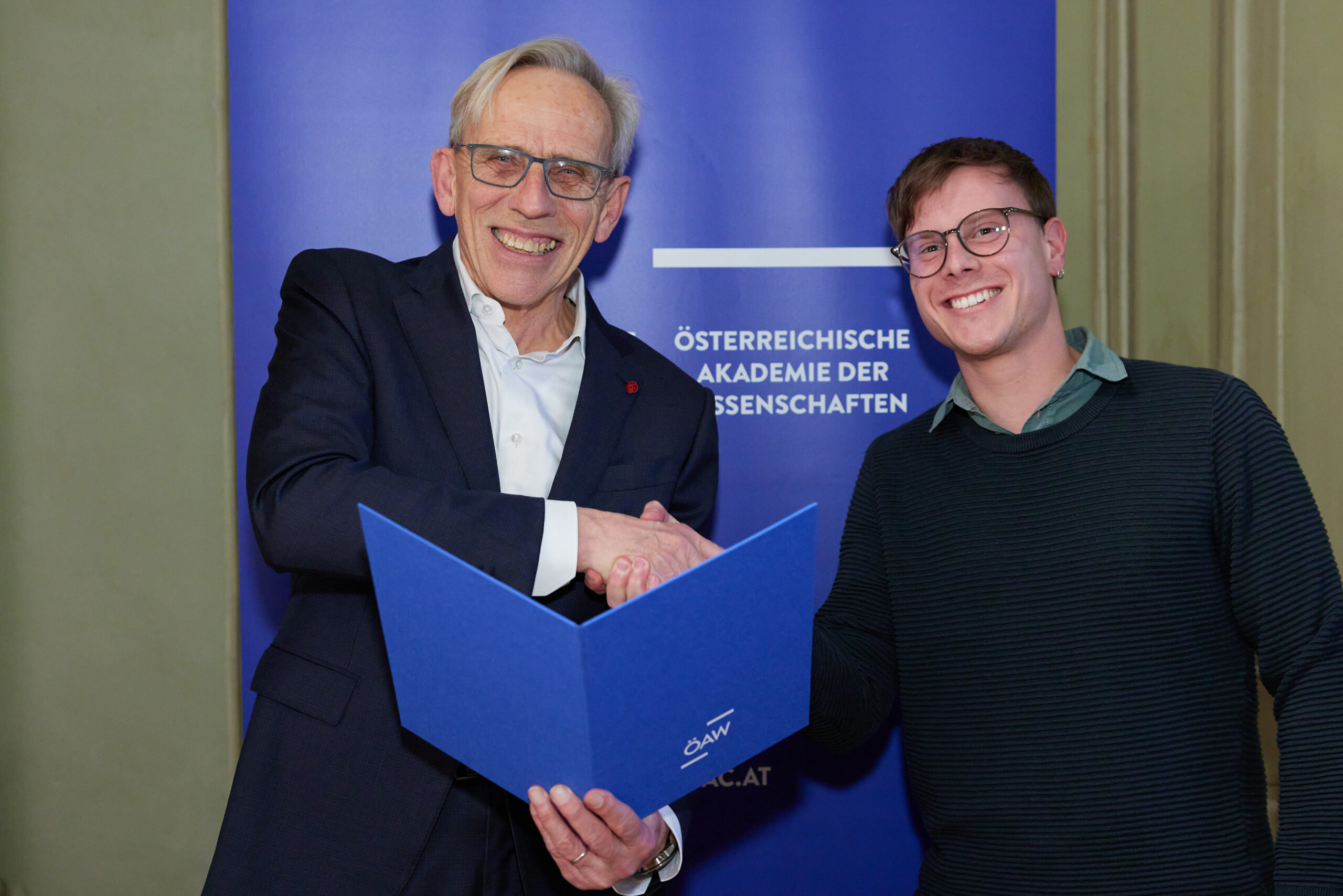
Receiving the W.E. Petraschek Award 2022 of the ÖAW
I am humbled and honored to receive the W.E. Petrascheck Award from the Austrian Academy of Sciences, which recognizes outstanding early-career earth scientists under 35 working in Austria, Bosnia and Herzegovina, Croatia, the Czech Republic, Hungary, Slovakia, or Slovenia.
Vienna, 31.01.2023